Domain-driven design (DDD)
19-6-2023 - updated 17-7-2023
Domain-driven design is a term introduced by Eric Evans in his book "Domain-driven design" from 2003.
But wait, that was 20 years ago! I hear you say. Yes, it was!
What can we learn from it?
These abstract ideas are still relevant today:
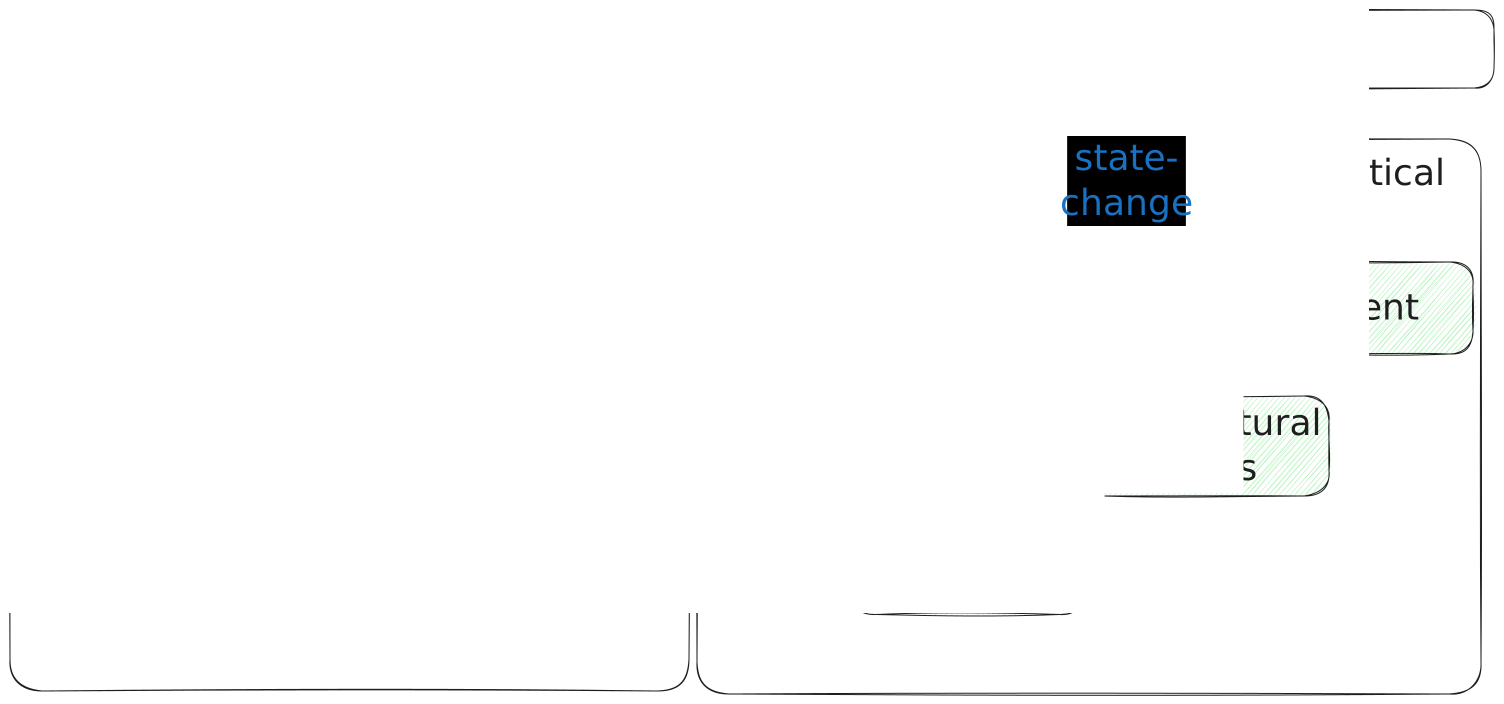
Strategic patterns
- Ubiquitous language: The structure and language used in the code matches the business domain
- Bounded context: the description of the boundary in which a model is defined or applicable
Tactical patterns:
- Entity object
- Value object
- Aggregate and factory
- Domain service
- Application service
- Infrastructure service
Trade-off
Why use it?
- Communication with the business is easier
- Improves flexibility: The domain is decoupled from application services and infrastructure services
- Domain over (user) interface: The application is build around the domain, and will be likely to produce an application better representing the domain at hand compared to a UI/UX-first approach.
Why leave it?
- Domain Expertise: It requires domain expert to be involved, and some time needs to be invested by the team to design.
- There is no domain: Say your domain has low complexity, or is not important. In that case, there is no need for domain-drive design.
About that last one: I have experienced people driving for DDD without a (complex) domain. There is no use solving a technical complex sequential protocol with DDD.
Conclusion
It is useful only for complex domains. If you have an easy domain, or simple procedural program, there is simply no need for DDD.
Resources
Domain Driven Design blog by Felipe de Freitas Batista
Code Opinion
Julie Lerman - The intersection of Microservices, domain-driven design and entity framework core
Milan Jovanovic
Amichai Mantinband